
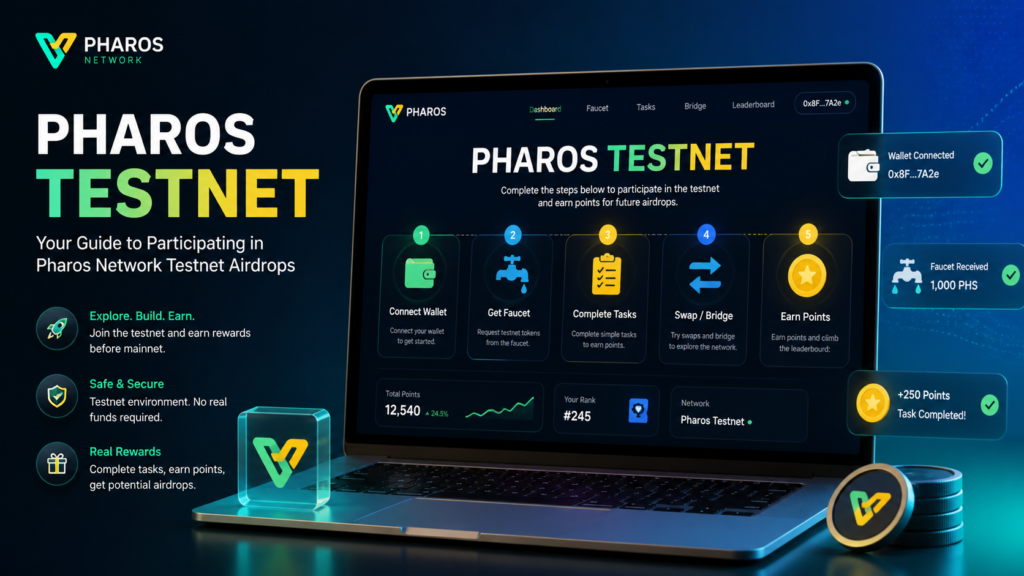
Pharos Network has become one of the latest testnet campaigns attracting attention from Web3 users and airdrop hunters.
The project describes itself as a fast EVM-compatible Layer 1 built for real-world assets, cross-chain liquidity, stablecoins, compliant finance, and tokenized financial products. In simple terms, Pharos is trying to position itself as infrastructure for financial applications that connect traditional assets with onchain markets.
For users, the most accessible way to explore the network is through the Pharos testnet.
A testnet is a pre-mainnet environment where users can try the network, interact with applications, test transactions, and complete campaign tasks without using real mainnet funds. In some cases, projects later reward active testnet users with token airdrops. But this is never guaranteed.
Why it matters
Testnet campaigns have become an important part of Web3 adoption.
They help projects stress-test their infrastructure before mainnet launch. They also allow users to become familiar with the ecosystem early, while giving the project data about wallet activity, transaction behavior, onboarding friction, and application usage.
For users, the appeal is simple: early participation may increase visibility inside the ecosystem.
If a project later decides to distribute tokens, active testnet users may be considered. However, users should be careful. A testnet campaign is not the same thing as a confirmed reward. There is no guarantee that participating will result in an airdrop.
The safer way to think about Pharos is this: you are testing a new blockchain ecosystem, learning how it works, and creating a participation history that may become useful if the project rewards early users.
How to participate
The first step is to visit the official Pharos testnet website:
https://testnet.pharosnetwork.xyz
From there, users can connect an EVM-compatible wallet. MetaMask, Rabby, OKX Wallet, or other Ethereum-compatible wallets may work, depending on the available options shown on the platform.
For safety, it is better to use a separate wallet created only for testnets and airdrop campaigns. Do not use a wallet that holds large amounts of real crypto.
After connecting the wallet, the next step is to add the Pharos testnet network if the website asks for permission. This allows the wallet to interact with the Pharos testnet environment.
Then users should look for the faucet.
A faucet provides free testnet tokens. These tokens are not real money. They exist only so users can test transactions, swaps, bridges, and other testnet activities.
Once the wallet has testnet tokens, users can start completing available tasks.
These may include actions such as claiming faucet tokens, checking in, swapping testnet assets, bridging between networks, interacting with partner applications, completing social tasks, or earning points on a leaderboard.
The exact tasks may change over time, so users should always follow the current instructions shown on the Pharos testnet dashboard.
What to do regularly
Airdrop campaigns usually reward consistency, not only one-time activity.
For that reason, users who want to participate seriously should check the dashboard regularly. If daily tasks, faucet claims, or recurring activities are available, it may be useful to complete them over multiple days.
A simple routine could look like this:
Connect your wallet.
Claim faucet tokens.
Complete available dashboard tasks.
Try a swap or bridge if available.
Check whether new ecosystem tasks were added.
Follow the official Pharos channels for updates.
This does not guarantee rewards, but it creates a cleaner activity history than logging in once and never returning.
Risk and safety
The most important rule is simple: do not connect your main wallet to every new testnet.
Use a separate wallet for campaigns. Never share a seed phrase. Never pay anyone to “unlock” an airdrop. Never send real funds to unknown addresses claiming to multiply rewards.
Also be careful with fake Pharos websites. Airdrop campaigns often attract phishing links. Always use the official testnet website and official project channels.
Testnet tokens have no real market value. If someone offers to sell testnet tokens, that is usually a red flag.
Market context
Pharos is part of a larger trend in Web3: the rise of high-performance Layer 1 networks focused on real-world assets, stablecoins, institutional finance, and cross-chain liquidity.
This matters because Web3 is moving beyond speculation alone. More projects are trying to build infrastructure for payments, tokenized assets, compliant finance, and financial applications that can serve both users and institutions.
If Pharos can attract builders, liquidity, and active users before mainnet, its testnet may become an important signal for future ecosystem growth.
But the testnet phase is still early. Users should treat it as an opportunity to explore, not as a guaranteed income source.
Final thoughts
Participating in the Pharos testnet is relatively simple: connect a wallet, claim testnet tokens, complete tasks, and stay active.
The opportunity is interesting because Pharos is building in areas that matter to the future of Web3: real-world assets, cross-chain liquidity, stablecoins, and onchain finance.
But expectations should remain realistic.
Airdrops are never guaranteed. The best approach is to participate safely, use a separate wallet, complete the available tasks, and follow official updates.
For users interested in early Web3 ecosystems, Pharos is worth watching.
Source
Pharos Network
Pharos Testnet
OKX Web3 – By Bruno Freires