
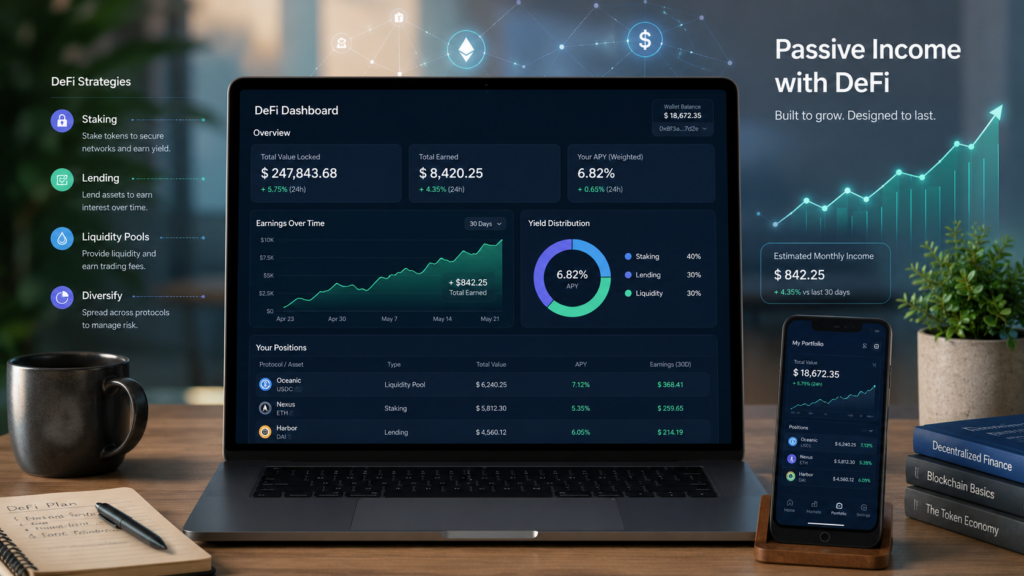
Decentralized finance has created new ways for crypto users to earn passive income without relying on traditional banks or brokers.
Instead of depositing money in a bank account, DeFi users can interact directly with blockchain-based protocols. These protocols allow people to lend assets, provide liquidity, stake tokens, and earn rewards from on-chain financial activity.
The idea is simple: users put digital assets to work, and the protocol pays them a return.
But DeFi income is not risk-free.
High yields can be attractive, but they can also hide serious risks. Smart contract failures, token volatility, liquidity problems, protocol hacks, and unstable reward models can all turn a passive income strategy into a loss.
That is why DeFi should be approached carefully.
Why DeFi income matters
DeFi matters because it changes how financial services are accessed.
In traditional finance, income products are usually controlled by banks, brokers, funds, or centralized platforms. In DeFi, users can access many income strategies directly through wallets and smart contracts.
This creates more flexibility.
A user can lend stablecoins, stake tokens, join liquidity pools, or move between protocols without asking permission from a financial institution. For people already familiar with crypto, DeFi can become a way to generate yield from assets that would otherwise sit idle in a wallet.
But the same openness that makes DeFi powerful also makes it dangerous.
There is usually no customer support team that can reverse a bad transaction. There is no bank manager to call if funds are sent to the wrong address. And if a protocol fails, users may not recover their assets.
The opportunity is real, but so is the responsibility.
The main ways to earn passive income with DeFi
There are three common ways to earn passive income in DeFi: staking, lending, and liquidity pools.
Each one works differently, and each one has its own risk profile.
1. Staking
Staking is one of the simplest DeFi income strategies.
In staking, users lock or delegate tokens to support a blockchain network or protocol. In exchange, they receive rewards. These rewards are usually paid in the same token or in another token connected to the protocol.
Staking can be attractive because it is relatively easy to understand. A user holds a token, stakes it, and earns rewards over time.
But staking is not the same as earning interest in a bank account.
The value of the token can fall. If the token price drops more than the staking rewards earned, the investor can still lose money. Some staking systems also include lock-up periods, meaning users may not be able to withdraw immediately.
Staking may work best for users who already believe in the long-term value of a token and are comfortable holding it through volatility.
2. Lending
DeFi lending allows users to deposit crypto assets into a lending protocol.
Borrowers can then borrow those assets by providing collateral. The lender earns interest, while the borrower gains liquidity without selling their crypto.
Stablecoin lending is one of the most popular forms of DeFi income because it can reduce direct exposure to token price volatility. For example, lending USDC or USDT may feel more stable than lending a highly volatile altcoin.
But lending still carries risk.
The lending protocol could be exploited. Collateral systems can fail during extreme volatility. Stablecoins can lose their peg. Borrowing demand can change, causing yields to rise or fall.
The safest approach is usually to focus on established protocols, understand the asset being deposited, and avoid chasing unusually high yields without knowing where they come from.
3. Liquidity pools
Liquidity pools are another major source of DeFi income.
In decentralized exchanges, users trade against pools of tokens instead of traditional order books. Liquidity providers deposit token pairs into these pools and earn a portion of trading fees.
For example, a user might provide liquidity to an ETH/USDC pool. When traders swap between ETH and USDC, the liquidity provider earns fees.
This can generate income, especially in pools with strong trading activity.
But liquidity pools come with a major risk: impermanent loss.
Impermanent loss happens when the price of the deposited tokens changes compared with simply holding them. In some cases, trading fees can offset this loss. In other cases, the liquidity provider may earn fees but still underperform a simple hold strategy.
Liquidity pools are more advanced than staking or lending. They require more attention to token pairs, volatility, trading volume, fees, and protocol risk.
How to start safely
The safest way to begin with DeFi is to start small.
A beginner should not move a large amount of money into a protocol just because the advertised APY looks attractive. The first goal should be learning how the process works.
A basic DeFi routine could look like this:
Create a separate wallet for DeFi activity.
Fund it with a small amount.
Use a well-known blockchain and a trusted protocol.
Test one simple strategy, such as stablecoin lending or low-risk staking.
Track deposits, rewards, fees, and withdrawals.
Avoid unknown links, fake airdrops, and promises of guaranteed high returns.
Security matters more than yield.
Many DeFi losses happen not because the strategy was bad, but because users clicked fake links, signed malicious wallet approvals, or connected their main wallet to unsafe websites.
Using a separate wallet can reduce damage if something goes wrong.
What investors should watch
The first thing to watch is the source of the yield.
If a protocol offers high returns, investors should ask where the money comes from. Is the yield coming from real trading fees, borrowing demand, staking rewards, token emissions, or temporary incentives?
Yield based on real usage is usually more sustainable than yield funded mainly by new token emissions.
The second thing to watch is total value locked.
A protocol with higher total value locked may have more market confidence, but that does not make it risk-free. Large protocols can still fail. However, extremely small protocols with unrealistic yields deserve extra caution.
The third thing to watch is smart contract risk.
DeFi protocols run on code. If the code has a vulnerability, funds can be stolen or locked. Audits can help, but they do not eliminate risk.
The fourth thing to watch is liquidity.
If it becomes difficult to withdraw or sell an asset, a passive income strategy can quickly become a trap.
The bigger picture
DeFi passive income is one of the most important use cases in crypto.
It shows how blockchains can support financial activity without traditional intermediaries. Users can lend, stake, provide liquidity, and earn rewards from open financial networks.
But the phrase “passive income” can be misleading.
DeFi income is not truly passive if users need to monitor risks, check protocol health, manage wallet security, understand token volatility, and avoid scams.
A better way to think about it is this: DeFi can generate on-chain yield, but it requires active risk management.
For beginners, the best strategy is not to chase the highest APY. It is to understand the mechanics, use small amounts, choose established protocols, and protect the wallet first.
The opportunity is real, but the market rewards discipline.
In DeFi, the safest income is usually not the highest income. It is the income that survives long enough to matter.
Source
Educational article
Bruno Freires