
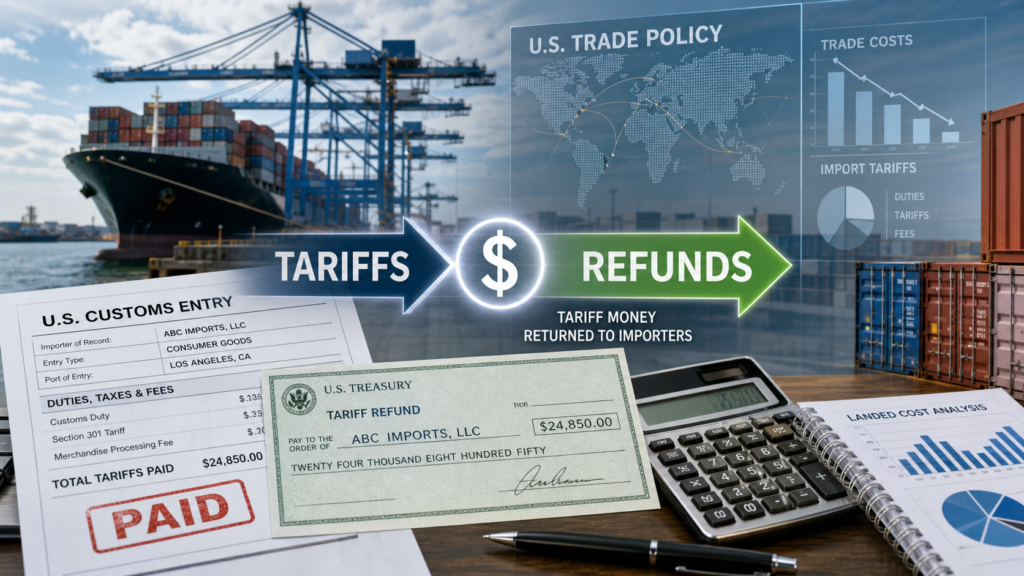
U.S. importers may soon begin receiving refunds from Trump-era tariffs, creating a new turning point in one of the most important trade policy disputes in recent years.
The U.S. Customs and Border Protection agency said the first electronic refunds could begin as early as May 12. The payments are connected to tariffs imposed under the International Emergency Economic Powers Act, after the Supreme Court ruled that the administration had overstepped its authority in using the 1977 sanctions law to impose those tariffs.
The numbers are significant.
According to the report, up to $166 billion in tariff collections could be subject to refunds. That makes this more than a legal story. It is also a major economic and market signal for importers, retailers, manufacturers, logistics companies, and consumers.
Why it matters
Tariffs are taxes on imported goods.
When companies pay tariffs, those costs do not disappear. They are usually absorbed by businesses, passed to consumers, or spread across the supply chain. Over time, tariffs can affect profit margins, retail prices, inventory decisions, and international trade flows.
If refunds begin, some companies may recover money that was previously treated as a cost of doing business.
That could improve cash flow for certain importers and reduce financial pressure on companies that were heavily exposed to tariffed goods. For businesses operating on thin margins, even partial refunds could matter.
But the impact will not be equal across the economy.
Companies that paid more tariffs, filed claims properly, and are eligible for refunds may benefit more directly. Other firms may see little immediate effect.
Market context
The tariff refund process arrives at a sensitive time for markets.
Investors are already watching inflation, interest rates, consumer spending, corporate margins, and global supply chains. Trade policy adds another layer of uncertainty.
If refunds return capital to businesses, they could provide limited relief to sectors affected by import costs. Retailers, manufacturers, distributors, and companies dependent on global sourcing may all watch the process closely.
At the same time, tariff refunds do not erase broader trade tensions.
The United States is still debating how aggressively it should use tariffs, sanctions, industrial policy, and trade restrictions. Companies must still plan for a world where supply chains are shaped by politics as much as by cost efficiency.
This is why the story matters beyond the refund date.
It shows that trade policy can create years of uncertainty — and that legal decisions can eventually reshape the financial outcome for businesses.
What investors should watch
The first signal to watch is the speed of refund processing.
If payments begin smoothly, companies may gain more confidence that the process is moving forward. If delays appear, the benefit may take longer to reach balance sheets.
The second signal is which sectors benefit most.
Import-heavy industries may receive more attention from investors if refunds improve cash flow or reduce pressure from past tariff costs.
The third signal is political response.
Tariffs remain a powerful policy tool. Even if one set of tariffs is reversed or refunded, future administrations may continue to use trade restrictions to pursue economic or geopolitical goals.
For investors, the larger lesson is simple: trade policy is not only about politics. It can directly affect corporate costs, consumer prices, margins, and market expectations.
The first refunds may begin soon, but the bigger issue remains unresolved.
Global trade is becoming more legal, more political, and more difficult for companies to predict. That uncertainty is now part of the market environment.
Source
Investing.com / Reuters